Australian ingenuity.
Unrivalled energy.
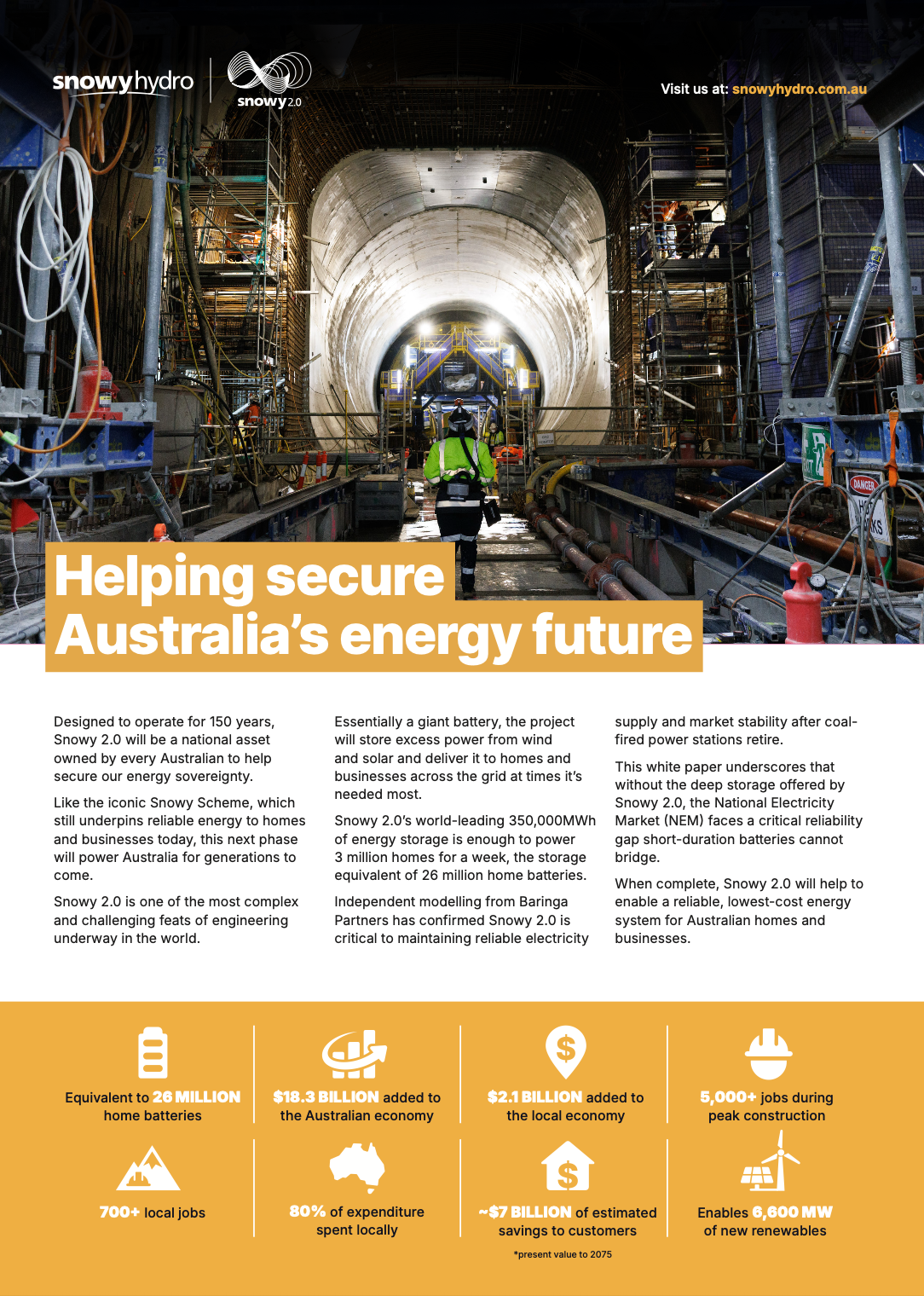
Snowy 2.0 will enable long-duration energy storage essential to providing security, reliability and stability to Australia’s energy grid.
The pumped hydro expansion of the iconic Snowy Scheme, Snowy 2.0 is one of the most complex and challenging feats of engineering underway in the world.
Essentially a giant battery, Snowy 2.0 will store excess power from wind and solar and deliver it to homes and businesses across the grid at times it’s needed most.
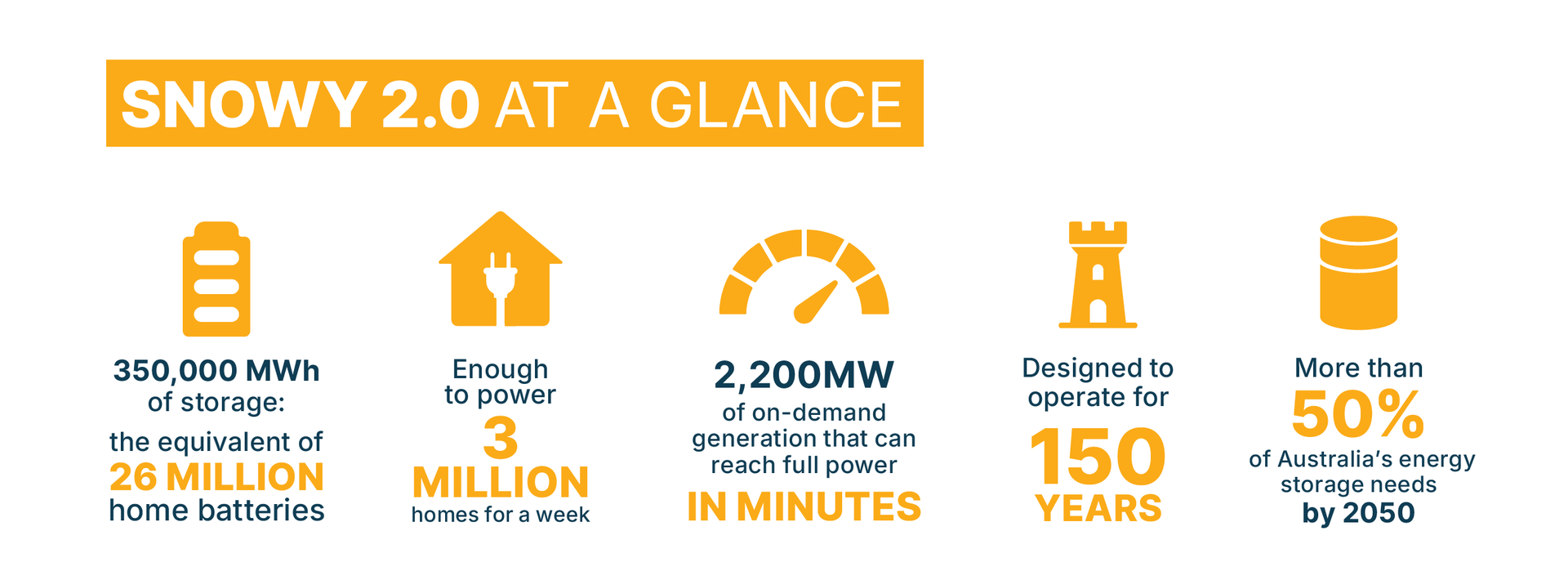
Snowy 2.0’s 2,200 megawatt (MW) capacity will deliver enough energy to power 3 million homes for a week, equivalent to about 26 million home batteries.
The Australian Energy Market Operator predicts the National Electricity Market (NEM) requires around 649 gigawatt hours (GWh) of dispatchable energy storage to reach net zero by 2050, Snowy 2.0 alone will provide more than half, providing the grid with an incredible 350,000MWh energy storage.
Designed to operate for 150 years, Snowy 2.0 will underpin clean energy in Australia for generations to come.
When complete, Snowy 2.0 will become the centrepiece of Snowy’s unmatched mix of on-demand power stations that provide the power and energy storage needed to keep the lights on in homes and businesses as more wind and solar enters the grid.
This will enable a reliable, lowest-cost energy system for Australia’s homes and businesses.
How Snowy 2.0 will keep the lights on
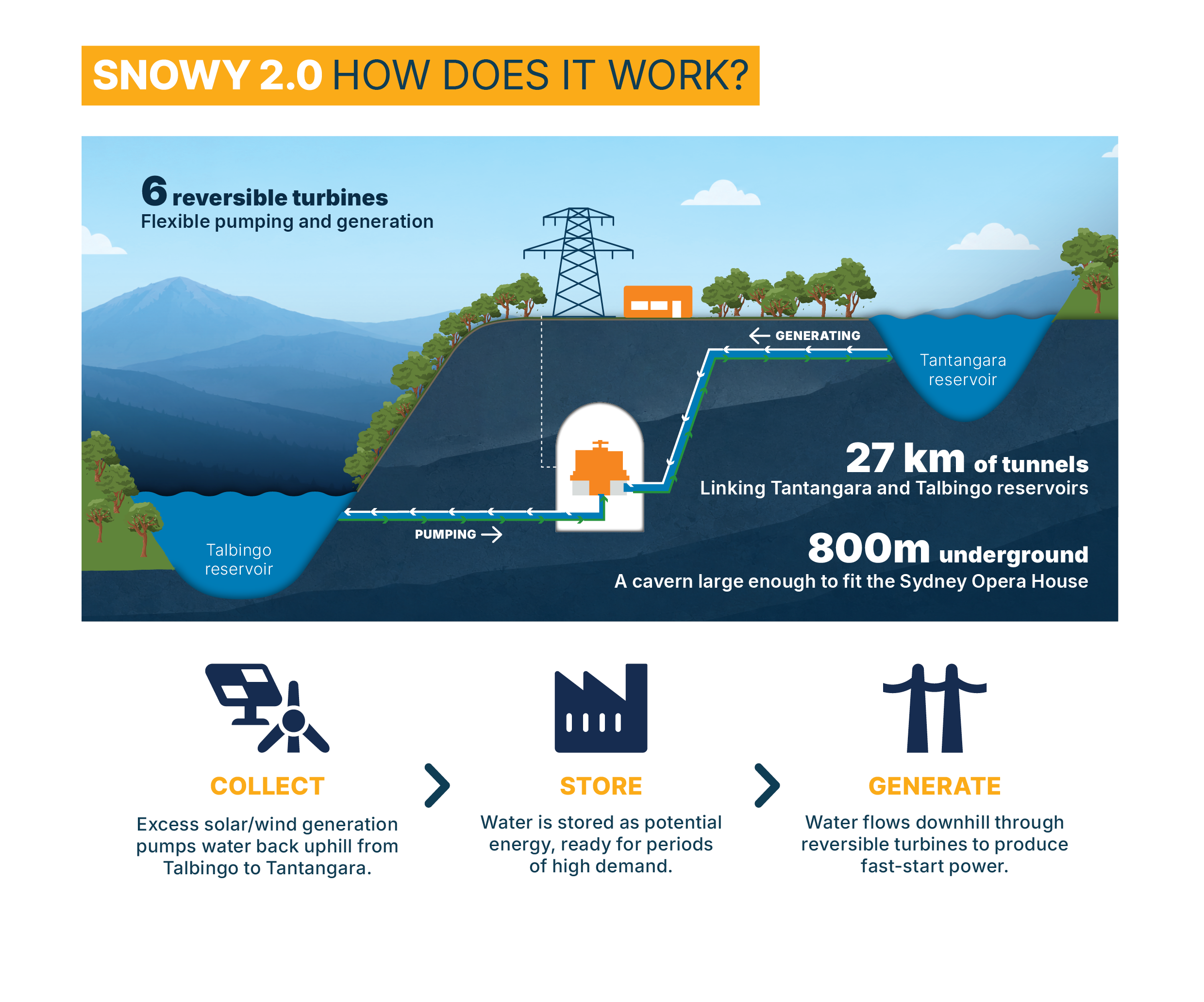
Snowy 2.0 is a world-leading pumped-hydro project that will significantly increase the Snowy Scheme’s electricity generation and storage capacity.
It will link two existing Scheme reservoirs – Tantangara and Talbingo – through 27 kilometres of tunnels and a new power station located approximately 800 metres underground at Lobs Hole.
Six reversible turbines in this power station will allow for water to be released for energy generation during times of peak electricity demand and then be pumped back up to the top reservoir at times of excess wind and solar.
The water will be recycled – it can be used for energy generation again and again.
Snowy 2.0 will provide vital large‐scale energy storage, along with quick‐start electricity generation at critical times of peak demand when energy supply is constrained and at times when intermittent renewable energy output is low.
Snowy 2.0 delivers for the grid and the economy
An independent report carried out by GHD highlights the widespread benefits of Snowy 2.0 on both Australia’s energy grid and the national economy.
As the nation’s biggest renewable energy project, Snowy 2.0 provides the deep storage required to support the renewables transition while safeguarding energy sovereignty and supporting affordability.
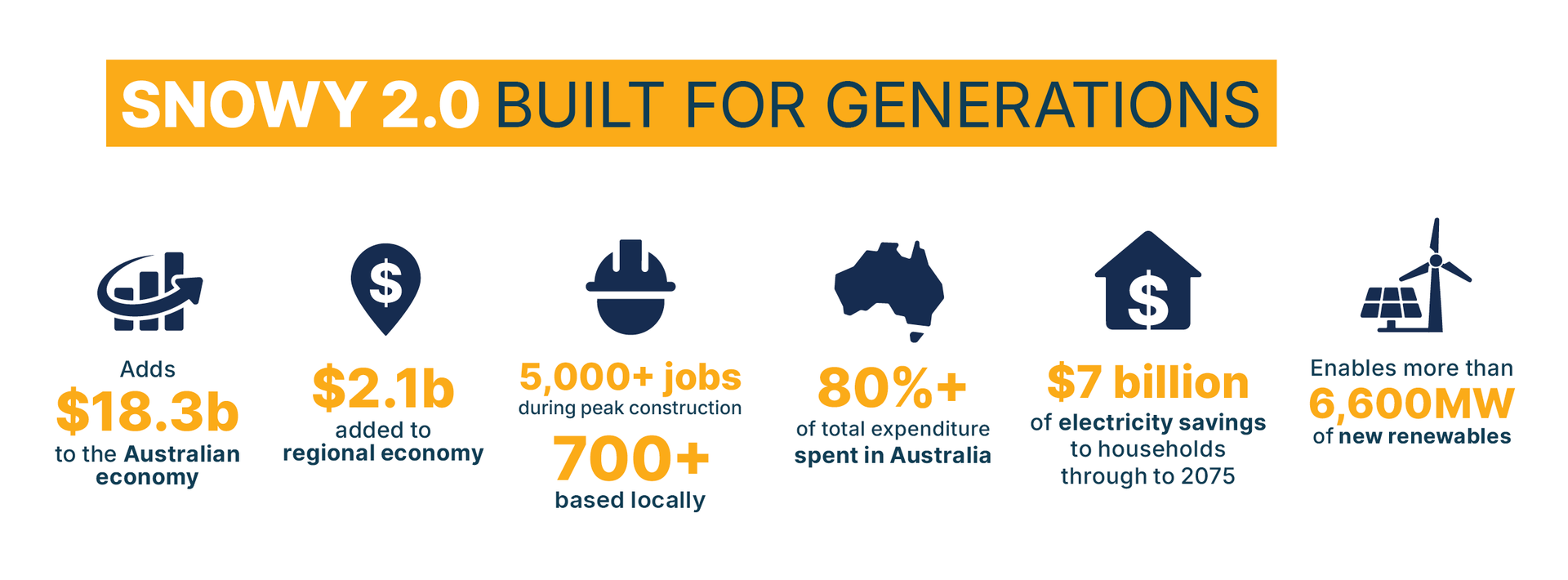
Over its construction and operational cycle, project expenditure will inject $18.3 billion into the Australian economy.
Construction activity supports the equivalent of 102,000 full-time one-year jobs nationwide, generating $9 billion in total wages and salaries.
Employment is projected to peak in 2027, supporting approximately 18,700 one-year jobs across the country.
Snowy 2.0 is estimated to deliver around $7 billion in household electricity savings in present value terms through 2075 by reducing the frequency and severity of extreme price spikes.
At the regional level, the project contributes $2.1 billion in value-added activity to the surrounding regional economy, with $1.5 billion directly benefiting the local economy around the Snowy Mountains.
By absorbing excess renewable generation during low-demand periods, Snowy 2.0 also enables an additional 6,600 megawatts of new wind and solar capacity to connect to the grid.
Click here to read GHD’s Snowy 2.0 Project Benefits Analysis.
Find out more